

It is easy to believe that we are still choosing. The songs we like, the opinions we form, the shows we watch all feel like expressions of who we are. But if you slow down long enough to notice the patterns, it becomes harder to defend that idea. The shape of our choices is no longer carved by circumstance or context. It is sculpted by simulation. Every scroll, every pause, every small gesture of attention is absorbed by a system that learns us faster than we can evolve. What used to be agency has become choreography. We move inside invisible boundaries drawn by algorithms that never force us, only persuade us. The illusion of freedom is maintained by comfort.
Emotion, once the most personal part of being human, has become the most public. It powers an economy that runs on engagement. Every trace of feeling is data. Our sadness, our excitement, even our boredom are signals the system translates into prediction. The machine does not need to coerce us. It only needs to keep us soothed enough to stay. Comfort has replaced control as the most efficient form of dominance.
Somewhere along the way, we stopped feeling through experience and started feeling through systems. We began to outsource the messy, unpredictable parts of living to devices designed to smooth them out. There was a time when emotion arrived from context, when we had to wait for the world to surprise us. Now emotion is streamed to us in perfect rhythm.
You can see this shift in what I call the Reality Gradient. On the far left lies the world we once inhabited, full of friction, slowness and uncertainty. Emotion grew from real encounters there, shaped by the weight of circumstance and the patience of time. In the middle sits the mediated world, where experiences are filtered through algorithms, trends and optimization. This is where culture begins to recycle itself and where our feelings are trained to match the feed. By the far right, simulation takes over. Emotion is delivered pre-packaged. It is smoother, faster, easier to handle. But with each layer of refinement, a layer of meaning disappears. The gradient moves upward in comfort and downward in context. What looks like progress is often only displacement, a gentle slide from reality to its reflection.
This gradient explains why modern life feels both hyper-real and strangely hollow. Every design that makes things easier also makes them thinner. Friction, the thing we once tried to eliminate, was what gave life texture. When everything works too well, you stop noticing that you are being worked on.
Friction was once failure. Now it might be freedom.
We still tell ourselves that our choices are driven by taste, but taste is no longer organic. It is generated by exposure. Trends do not rise from culture; they are manufactured by correlation. When millions of people see the same thing at the same moment, desire begins to sync. The system no longer needs to convince us; it only needs to keep us watching long enough for our preferences to align. The more we align, the more predictable we become. The more predictable we become, the easier we are to please.
Think of it like Spotify for the soul — an endless auto-play of feelings calibrated to keep you from ever sitting in silence.
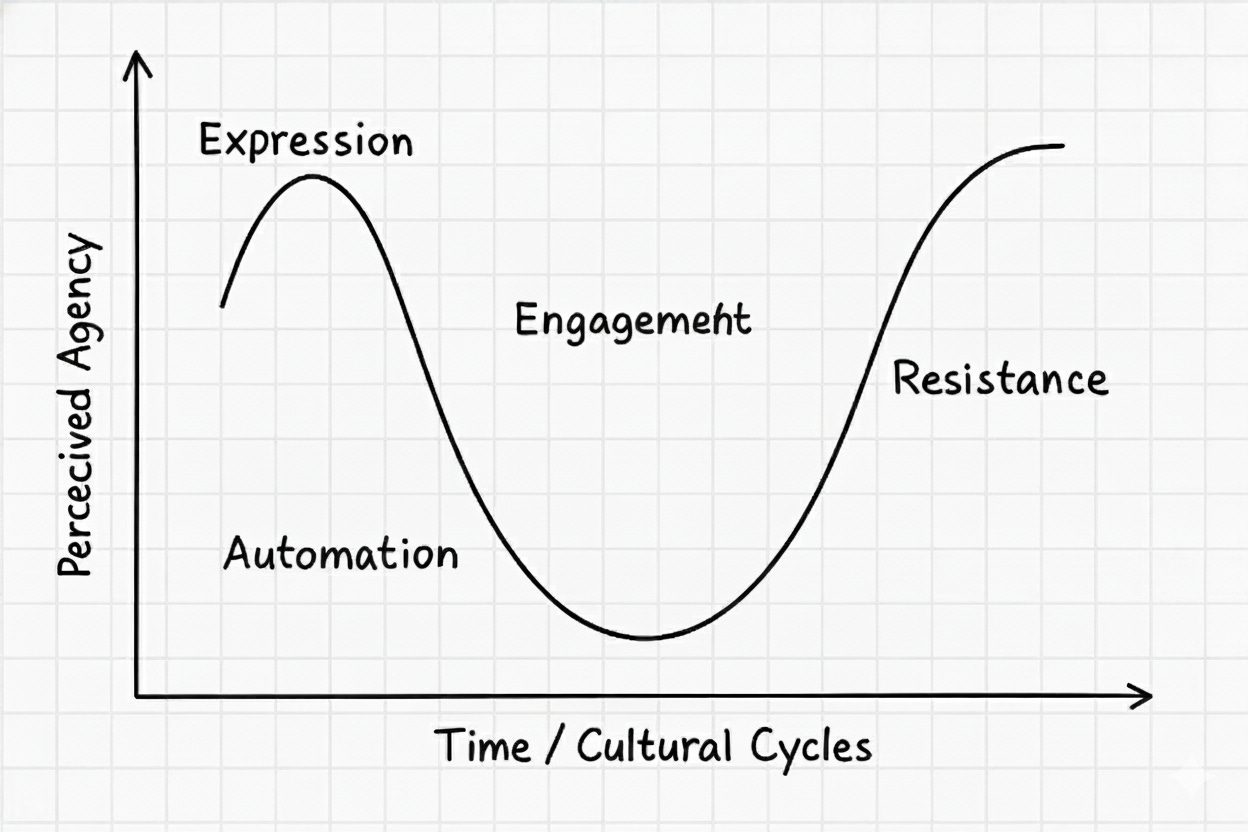
Trends feel familiar because they are trained to be. What feels new is often only newly repeated. The simulation learns the rhythm of novelty so well that surprise itself becomes a template. Every rebellion is absorbed as soon as it appears, turned into another option to click. Even resistance has been automated.
Abundance was meant to free us. Instead, it has paralyzed us. When everything is available, the meaning of choice collapses. You no longer decide because you want to; you decide because you have to keep moving. The algorithm does not just respond to your desire. It creates the horizon of what you are allowed to desire. Belief, too, has followed this path. It no longer grows from conviction but from repetition. The more something is shown, the truer it feels. The feed has become a kind of soft religion. We return to it not for truth but for reassurance that we still exist inside its loop.
Culture mirrors its architecture. Art used to lead us toward what we could not yet name. Now it reflects what we already know. Every frame, phrase and image is trained on metrics of recognition. We confuse recognition with resonance, and in doing so we lose both. The modern creator is less a prophet than a pattern reader. They work with the data of feeling rather than the feeling itself.
The algorithm doesn’t predict the future. It recreates the past — just faster.
Underneath all this is the quiet industrialization of emotion. Feelings are no longer spontaneous or private. They are scheduled, optimized, and renewable. Outrage, guilt, nostalgia, and longing each have their frequency and ideal decay. The system understands that guilt keeps us scrolling. It knows that outrage renews attention. The emotions that sustain engagement are the ones that survive.
And yet, in this perfect simulation, a small hunger persists. People are starting to crave the rough edges again. The mistakes, the silences, the things that do not adjust. There is a reason the analog, the unfiltered, and the uncertain feel suddenly sacred. They remind us that emotion was once something that happened to us, not something we selected from a menu. We are learning that unpredictability is not a flaw in the system; it is the last trace of humanity left inside it.
This may become the defining divide of the coming years. On one side will be those who remain fluent in simulation, living in emotional comfort engineered by design. On the other will be those who choose friction. They will seek the slow, the confusing, the inconvenient. They will treat imperfection as proof of life. The future will not split by wealth or access but by texture between people who want everything seamless and people who want something real.
When everything begins to feel right, the ability to feel wrong disappears.
Because when you lose that, you lose the ability to grow. The rebellion of the next generation will not be against machines but against prediction.
When feeling becomes code, mystery becomes resistance. To remain human will mean to stay unpredictable.